MarvelX Team
How to Evaluate AI Claims Agents: Six Criteria That Hold Up in an Audit
Six questions to ask an AI claims agent vendor before signing: explainability, oversight, data residency, integration, proof, and how accuracy is defined.

Every vendor demo of AI claims agents looks the same. A clean approval, a confident number, and a screen that never shows the claim that goes wrong. The hard questions come later, from an auditor or from a policyholder disputing a settlement, and by then the contract is signed.
We built this list with claims teams who had sat through a dozen demos and still could not say which vendor would survive an audit. Six criteria kept coming up: explainability, human oversight, data residency, core-system integration, realized proof, and accuracy with a definition. Each one comes with a question you can ask in the room and the kind of answer that should end the conversation.
The six criteria at a glance
The table below is the short version. Each row pairs a criterion with the question to put to the vendor and the answer worth hearing. Take it into the room with you.
The question to ask | The answer worth hearing |
|---|---|
Explainability. “Reproduce one decision from this demo, live.” | A trace an examiner could read: the documents, the rules that fired, the outcome. |
Human oversight. “Where does a claim route back to a person, and who sets that threshold?” | A threshold you set and can point to in writing, with every claim prepared for a person to decide. |
Data residency. “Where is claims data stored and processed, and which regime governs it?” | Your region as standard, with DPA and sub-processor questions closed in days. |
Core-system integration. “Do you work inside our claims system, or do you expect us to move off it?” | Standard APIs and webhooks, with your system staying the system of record. |
Realized proof. “Which of these figures are realized with a client who signed off?” | A named deployment behind every number, bound to its own client and segment. |
Accuracy, defined. “How do you define accuracy, and can you measure it on our live claims?” | One definition, agreed before go-live and measured on live claims. |
Explainability: can the vendor reproduce a decision on demand?
Pick one decision in the demo and ask the vendor to reproduce its full reasoning, live. A good answer is a trace an examiner could actually read: the documents that fed the decision, the rules that fired, the outcome. If the trace needs a support ticket, or the explanation is that the model decided, move on.
When a policyholder disputes an outcome, you have to show the reasoning behind it. More than 20 US states have adopted the NAIC’s model bulletin on AI, which asks how explainable outcomes are to the consumer. State insurance examiners began piloting an AI evaluation tool in January 2026. Sooner or later someone outside your company will ask to see a decision.
Human oversight: where is the route back to a person?
An AI claims agent should prepare every claim for a decision and put a person in charge of making it. Your team reviews every claim until you decide otherwise. How much the system does on its own is a setting you control, so agree the starting position before go-live and ask where it is documented.
EIOPA’s August 2025 opinion on AI governance expects human oversight across the whole lifecycle of an AI system. European supervisors will read your review design in that light. The figure below is the shape to ask every vendor to draw.
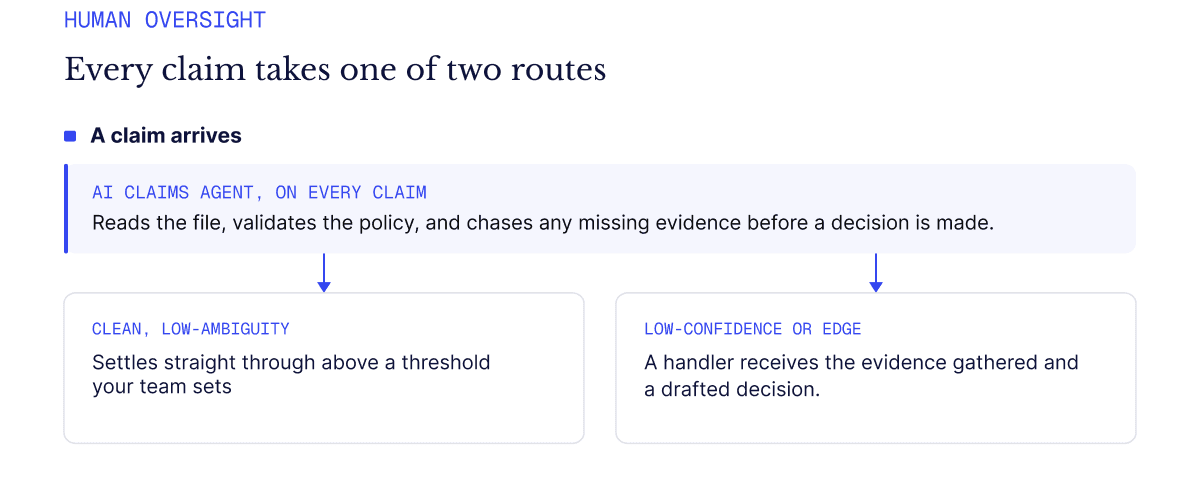
Ask what the handler sees when a claim reaches them. They should open a file with the evidence already gathered and a drafted decision, and review it in minutes rather than building the file from scratch.
Data residency: is compliance settled before signing?
Name the residency requirement for your region before the first demo. A vendor that has done this before can tell you where claims data is stored, where it is processed, and which regime governs it. DPA and sub-processor questions get answered in days, not weeks, and residency in your region comes as standard. If it is on the roadmap or priced as an upgrade, treat that as a no.
For a regulated insurer, residency decides whether a vendor is eligible at all.
MarvelX documents its own answer on the security page.
Core-system integration: does it run alongside your claims system?
Ask the vendor directly: do you work inside our claims system, or do you expect us to move off it? The strongest vendors connect to the core system you already run through standard APIs and webhooks, and that system stays the system of record. Your reporting and your workflows don’t change.
You should not need a migration project to try an AI claims agent. A rip and replace turns a claims decision into an IT program.
Proof: which figures are realized, and which are targets?
Ask which figures come from live claims with a client who signed off, and which are still goals. A contracted target describes ambition. A realized outcome tied to a client and a segment describes track record, and the two deserve different standards.
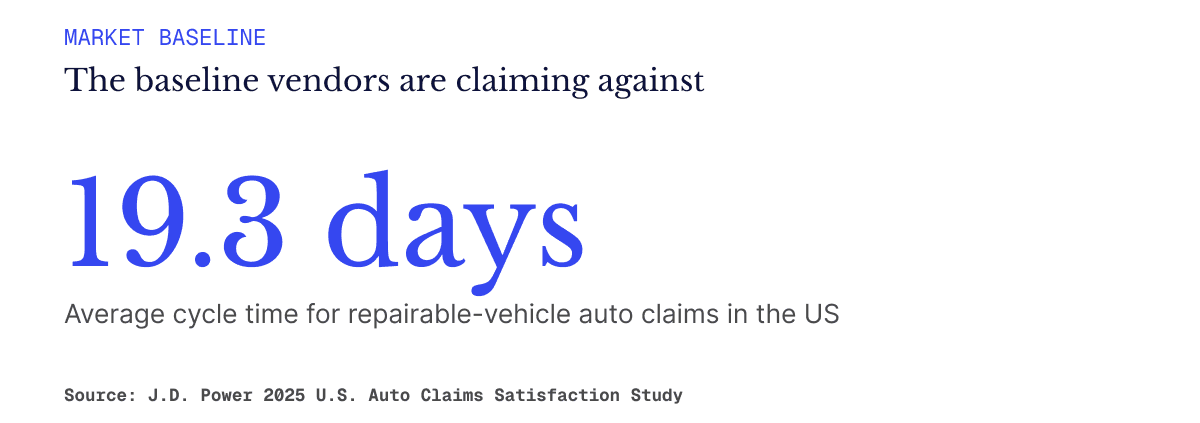
Hold one market baseline in mind while you listen. J.D. Power’s 2025 US Auto Claims Satisfaction Study puts average cycle time for repairable vehicle claims at 19.3 days (the card below). A vendor quoting minutes against that baseline should be able to name the deployment behind the number.
Accuracy: is there one definition, measured on live claims?
Ask every vendor to define accuracy the same way, then ask to see it measured on your claims rather than a curated demo. An accuracy rate means nothing without a definition and a live sample, and speed without a defined accuracy bar only moves the risk downstream.
MarvelX agrees the definition with each client before go-live and measures against it on live claims, with cross-document consistency and entity-legitimacy checks running underneath.
Score every vendor the same way
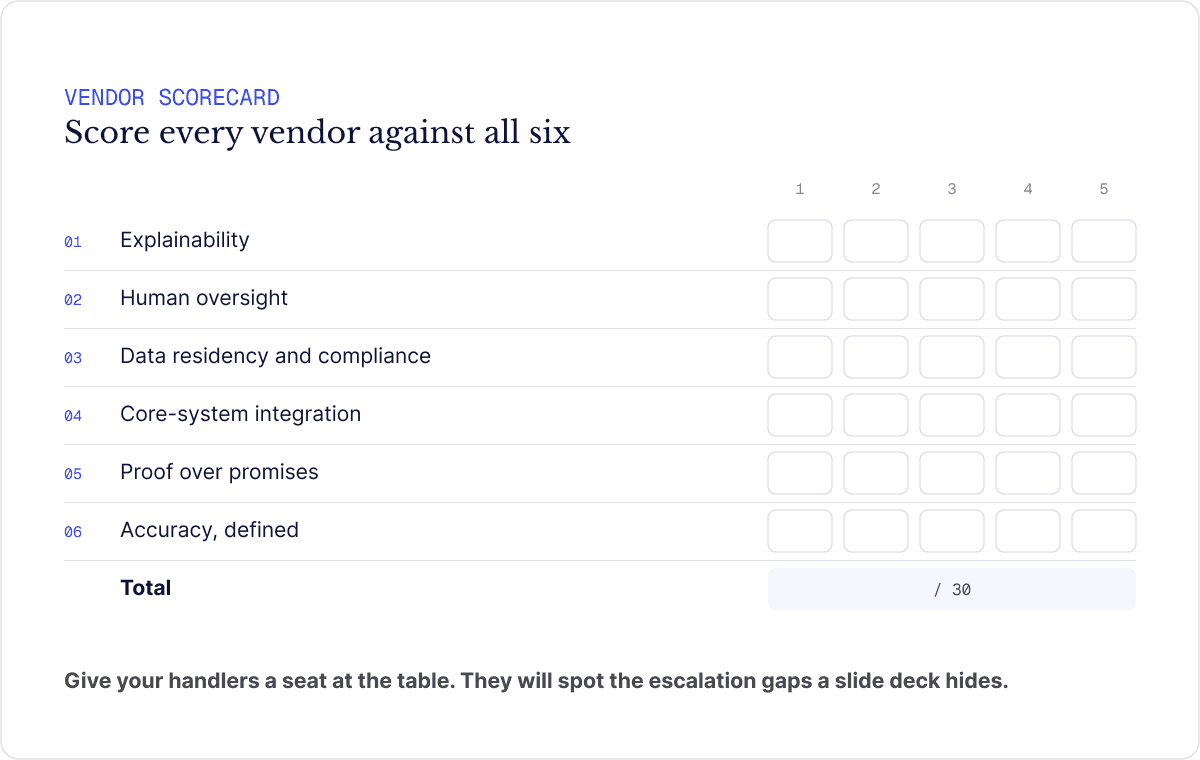
Score each criterion from 1 to 5, weight them equally, and total out of 30. Copy the table above into one sheet per vendor and keep the sheets. The total structures the conversation, but treat a vendor that fails any single criterion as rejected, whatever the number says.
And bring your handlers into the scoring session. They will notice what a slide deck hides, like a demo that never once shows a claim being kicked back.
Before the first demo
Send the six questions to every vendor in writing before the demo is booked, and hold each one to all six. Run them before the demo sways anyone. The vendors worth shortlisting answer quickly and in specifics, because they have been asked before.
Request a demo
Frequently asked questions
What is an AI claims agent?
An AI claims agent is software that processes an insurance claim end to end. It reads the file, validates the policy, chases missing evidence, and prepares a decision with a full audit trail. Which claims move through on their own is a setting the carrier controls; claims that need judgment go to a handler with the evidence and a drafted decision attached.
Unlike scripts built on robotic process automation (RPA) or static rules, an AI claims agent keeps working when the inputs change. A repair shop can redesign its invoice template and the claim still moves. In live deployments, claims handling moves from days to under an hour.
Do AI claims agents replace claims handlers?
No. The agent clears the high-volume routine claims, and handlers keep the cases that need judgment. Escalated claims arrive with the evidence gathered and a decision drafted, so the handler’s time goes to the decision itself.
Do we need to replace our core claims system?
No. An AI claims agent should connect to your existing claims, policy, and CRM systems through APIs and webhooks. Your current platform remains the system of record, and there is no migration project before the first claim is processed.
How should accuracy be measured during a pilot?
Agree one definition of accuracy before the pilot starts, then measure it on your live claims rather than a sample the vendor selects. Report it next to the automation rate and the straight-through rate.